Black White Cat Line Art
A Designer’s First Look: Clean, Quiet, and Full of Charm
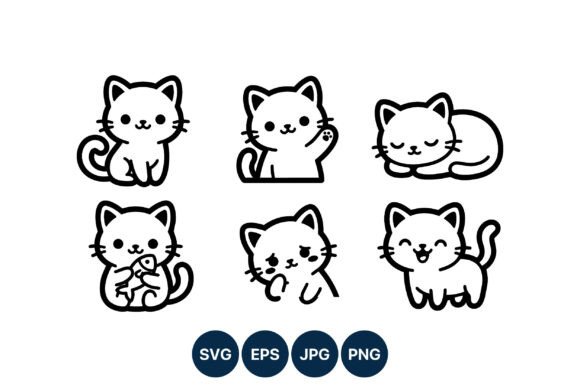
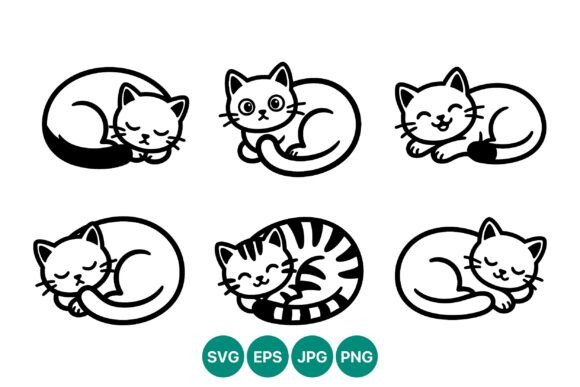
When I opened the Black White Cat Line Art ZIP folder, what struck me first wasn’t complexity—it was calm. Six cats, each drawn with confident, unbroken lines—no shading, no gradients, no noise. Just pure silhouette energy: a curled-up sleeper, a perked-up sitter, a mid-pounce twist, all with closed eyes or gentle half-lids. This isn’t cartoonish or cutesy; it’s quietly expressive. The line weight stays consistent across poses, which tells me the illustrator understood embroidery constraints—not just illustration aesthetics. That consistency is gold when you’re translating flat art into stitch.
Where It Lives Best: Real Projects, Not Just Pixels
I tested one of the smaller cats—a seated pose with tail looped neatly around its paws—on a natural linen tea towel. Used a medium-weight cutaway stabilizer, 40-weight cotton thread, and a 5×7 hoop. The result? Crisp, legible, and surprisingly warm. Customers don’t buy “line art”—they buy *feeling*. And this set delivers softness without saccharine. I’ve already sketched out how it’ll work on:
- Embroidered baby onesies—the sleeping cat fits perfectly on the chest, reads clearly at 2.5”, and feels soothing, not busy;
- Canvas tote bags for indie bookshops—the alert-sitting cat adds quiet personality without competing with typography;
- Patches for denim jackets—clean outlines mean sharp edges after trimming, and the lack of fill areas keeps stitch time low and durability high;
- Nursery pillow covers—paired with tone-on-tone thread (ivory on oat, charcoal on slate), it reads as texture, not decoration.
What Holds Up—and What Needs Thought
The Black White Cat Line Art thrives where simplicity meets intention. On stable fabrics like twill, canvas, or medium-knit sweatshirt fleece? Excellent. The line work translates cleanly into running stitch or satin stitch borders—no dense fill areas to pucker or overwhelm lightweight materials. But here’s where judgment matters:
- Small hoop sizes (under 3”): One playful cat with tightly coiled tail has finer loops—test that one first. At under 2”, those curls risk merging in stitch.
- Stretchy or thin fabrics: Skip the satin-stitch outline unless you double-stabilize. A running stitch perimeter works better on t-shirts or baby rib knit.
- Dark or textured backgrounds: Since these are line art only, contrast depends entirely on thread choice. Always mock up in black *and* white thread on your actual fabric swatch—what reads on screen won’t always read under light or after washing.
- Curved surfaces (caps, curved aprons): Stick to the more open poses—the sleeping cat with wide negative space adapts better than the tightly wound playful version.
Why It Builds Trust—Not Just Stitches
As an Etsy seller and custom embroidery designer, I know buyers scan fast. They’re not reading your shop policy—they’re checking if your product feels *handmade*, *considered*, and *cohesive*. The Black White Cat Line Art supports that instinctively. Its restraint makes finished pieces look intentional, not clip-art. When stitched on a cream linen kitchen towel with grey thread, it doesn’t scream “embroidery file”—it whispers “curated detail.” That subtlety lifts perceived value. Customers pay more for quiet confidence, not visual clutter.
It also plays well across branding. If you run a small shop selling handmade pet-themed goods, this set gives you six distinct moods—calm, curious, cozy—that align with real cat behavior. No forced grins. No exaggerated features. That authenticity builds recognition and repeat engagement, especially among thoughtful buyers who follow makers, not trends.
Practical Notes Every Embroiderer Should Run Through
Before cutting fabric or loading a hoop, do these five things:
- Test on scrap fabric—not just the same fiber, but the same weight and stretch. Linen behaves differently than cotton poplin, even if both are “lightweight.”
- Check thread color contrast in natural light *and* under your sewing lamp. A soft charcoal thread may vanish on heather grey until washed.
- Review stitch density—even line art can have tight corners or overlapping paths. Zoom in on your embroidery software. If two lines cross at a sharp angle with no gap, they may merge in stitch.
- Confirm hoop size vs. design footprint. These cats range in scale—some fit easily in a 4×4; others need 5×7. Don’t assume uniform sizing.
- Verify licensing for commercial use. Since this is labeled as Graphics and Illustrations, confirm whether resale of finished embroidered items (like patches or totes) is permitted—and whether digital redistribution (e.g., as part of a craft bundle) is allowed.
Final Thought: A Design That Serves the Maker
This isn’t flashy. It won’t trend on Pinterest overnight. But the Black White Cat Line Art is built for longevity—not algorithm appeal. It works for the craft fair vendor stitching 20 tote bags before dawn, the boutique owner updating seasonal nursery decor, the Etsy seller bundling digital + physical cat-themed kits. It respects fabric, thread, time, and taste. In a market flooded with overworked, over-digitized files, restraint is the rarest luxury. Use it thoughtfully, test it honestly, and let the cats do what they do best: sit quietly, sleep deeply, and hold space for real making.